PRESENTERS | REGISTER | SCHEDULE | TRAVEL/HOTEL | SPONSORSHIP/ADVERTISING
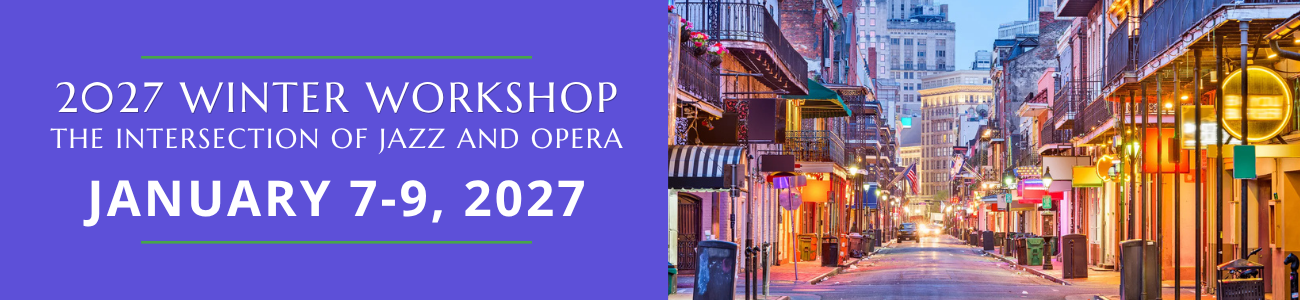
2027 Winter Workshop Schedule
All sessions will be held in Nunemaker Auditorium at Loyola University New Orleans
6301 St. Charles Avenue, New Orleans, LA 70118
- Thursday, January 7: Registration opens at 8:30 a.m. Sessions 9:30 a.m. - 5:30 p.m. CT
- Friday, January 8: Registration opens at 8:30 a.m. Sessions 9 a.m. - 5:30 p.m. CT with a reception and performance in the evening
- Saturday, January 9: Registration opens at 8:30 a.m. Sessions 9 a.m. - 5:00 p.m. CT
Session Titles and Descriptions
 Broadening Your Palette: How Approaches from Jazz Can Expand Your Teaching, from Lyric Interpretation and Harmonic Awareness to Extended Techniques and Master Class posted on 3:10 PM, October 2, 2026 Broadening Your Palette: How Approaches from Jazz Can Expand Your Teaching, from Lyric Interpretation and Harmonic Awareness to Extended Techniques and Master Class posted on 3:10 PM, October 2, 2026 |
|---|
Presented by Dominique Eade We will think of jazz not as a style to imitate, but as a genre that allows for exploration of sound, vowel color and text beyond conventional diction; rhythmic exploration and ear training for improvisation, and embodiment of musical awareness. The improvisational approaches of jazz can deepen one’s sense of line and delivery whether the student is investigating other genres of music, or simply applying these perspectives to classical repertoire. |
| Facing the Fear of Improvisation posted on 3:10 PM, October 2, 2026 |
Presented by Liz Johnson No matter what genre we sing, improvisation can be a practice tool to foster fluid self expression. Neuroscience now shows that improvising music turns off areas of the brain associated with self criticism and mental commentary, and naturally engages parts of the brain associated with freedom of expression and joy. In other words, you can’t “edit” and improvise at the same time. The first hurdle to practicing improvisation, however, is facing the FEAR of improvisation. Many, if not most, classically trained musicians feel a sense of trepidation about “getting off the page.” It makes sense why we feel afraid, especially if parts of the brain associated with improvising music have not been properly exercised or tapped into. No one has ever taught us how to start or what the rules are, either! This spotlight session will present fMRI research about the improviser’s brain, give a concise definition of musical improv, and break down some of the negative belief systems we all hold about improvising. Then, we will experience simple, fun, and effective exercises to bypass fear and start discovering the joy of freely improvising music - a practice that can be done almost anywhere or any time. Born out of 20+ years of teaching foundational jazz improvisation skills, this workshop will help us reconnect to both the joy of music making and also free our minds to “go for it.” |
| Improvisation for the Classically Trained Singer: Unlocking Freedom, Musicianship, and Expression posted on 3:11 PM, October 2, 2026 |
Presented by Zoe Leger Improvisation is often viewed as a specialized jazz skill rather than an essential component of comprehensive musicianship. For many classically trained singers, improvisation can feel intimidating, unfamiliar, or even incompatible with traditional vocal training. Yet improvisational practice offers powerful tools for developing artistic freedom, embodied musicianship, collaboration, and expressive confidence across all vocal styles. This interactive workshop explores improvisation as an accessible and valuable practice for classical singers and voice teachers. Drawing from jazz pedagogy, contemporary vocal training, and somatic approaches to voice and performance, participants will engage in practical exercises designed to reduce fear, increase spontaneity, and deepen interpretive connection. Topics will include improvisation as musicianship training, rhythmic flexibility, text-based improvisation, call-and-response exercises, self-accompaniment strategies, and the relationship between improvisation, nervous system regulation, and performance anxiety. Attendees will actively participate in guided vocal and rhythmic activities that can be adapted for private studios, collegiate teaching environments, and ensemble settings. This session aims not to transform classical singers into jazz vocalists, but to provide pedagogical tools that encourage curiosity, creativity, adaptability, and authentic artistic expression. As today’s singers increasingly navigate multi-genre careers, improvisation may serve as an essential bridge between technical mastery and artistic freedom. |

 |
RSS |
| The Road Was Always There: Jazz as the Bridge to Popular Singing posted on 3:14 PM, October 2, 2026 |
|---|
Presented by Alison Crockett A road map from classical training to popular singing has always existed. It runs through Black American Music, and Jazz can be its bridge. We will move through Spirituals, Blues, and Jazz highlighting Roland Hayes, Bessie Smith, and Sarah Vaughan, illuminating the pedagogical pathway to Jazz for the Classical singer. These three artists reveal the Blues-inflected Spiritual with its African vocal character and call and response, the Blues woman's legato swing rooted in speech rhythm, and the Jazz singer's ornamental phrasing and pocket that opened the door to everything Popular singing became. This workshop will center the oral tradition, honoring listening and transcription alongside vocal exercises that function differently than Classical pedagogy. Rather than approaching Popular music styles through belting and chest registration, this clinic will work through registration issues through the cultural lens of Black American Music: using duple and triplet rhythms to find the pocket, movement rooted in Jazz traditions, and using BAM Vocal Improvisational Tools to create phrasing which leads to riffing. Jazz does not separate technique from story. Emotional truth and vocal craft arrive together. Classical pedagogy is designed to help the singer find a specific sound and discover their artistry through that lens. Jazz is about the singer finding their own sound and story through the music, which is the basis of Popular singing. In order to get there, there is no leaping over Jazz from a Classical singing background. This clinic will illuminate that pathway. |
| Beyond the Page: African American Aesthetics Journey from the Hush Harbor to the Operatic Stage posted on 3:14 PM, October 2, 2026 |
Presented by Ollie Watts Davis In this session, Dr. Ollie Watts Davis shares her inspiring journey as an artist and performance scholar of the solo and choral music of African Americans, with particular attention to aesthetic choices, and authenticity in presentation. Vocal music in African American contexts exhibits unique treatment of the elements of music that are often referred to as Black music idioms. As a major character in Black American history, Black music provides the soundtrack of the Black experience in America, and sounds characteristic themes of liberation, hope, and inspiration through the celebrated medium of storytelling. With communal pedagogy and oral transmission as the origin system of learning, and the historic Black Church as the training ground for acquiring capacity and competency, the lyrics and styles of delivery embrace collective consciousness while highlighting heritage and history as expressed in the spiritual, pain as expressed in the blues, complexity as expressed in jazz and soul, and joy and hope as expressed in gospel songs. Using the improvised American hymn, ‘Amazing Grace,’ and the aria ‘Peculiar Grace’ from Terence Blanchard’s “Fire Shut Up in my Bones,” Dr. Davis will lead a brief, yet spectacular discovery of cultural contribution that adds value to the human condition. |
| From the Center, Out: Jazz, African American Aesthetics, and the Singer as Co-Creator posted on 3:15 PM, October 2, 2026 |
Presented by Alexis Davis Hazell & Earl Hazell From the Center, Out: Jazz, African American Aesthetics, and the Singer as Co-Creator, centers jazz as a foundational framework for reimagining vocal performance practice and pedagogy. Rooted in African American musical traditions, jazz positions the singer as an active co-creator whose interpretive choices, shaped by cultural, psychological, and lived experience, generate meaning in real time. Recognizing jazz as a complete system of vocal artistry, we explore how a jazz-informed perspective can expand and transform operatic practice. In this session, jazz-informed approaches to vertical harmonic awareness and embodied rhythm are demonstrated as mechanisms for increasing expressive nuance and informing approaches to operatic character development. Next, prioritizing the performer as a singing actor, session work emphasizes storytelling as the driving force behind vocal decision-making. Musical elements such as pitch, rhythm, articulation, and timbre are explored as compositional tools through which singers actively construct dramatic meaning. The session briefly situates these practices within historical context, drawing connections between improvisatory traditions in Baroque opera and jazz as models of performer-driven expression. Through side-by-side exploration of a jazz standard and an operatic excerpt, participants will engage strategies for improvisation, moment-making, and expressive interpretation. We invite participants to shift from reproducing sound to creating meaning, cultivating a flexible, historically grounded, and culturally aware approach to vocal artistry. |
| Imitation, Assimilation, & Innovation: Approaches to Jazz Performance Practice for the Classical Voice posted on 3:24 PM, October 2, 2026 |
Presented by Lara & Robert Brooks The great jazz trumpeter Clark Terry described learning jazz in three simple words: “Imitate, Assimilate, & Innovate.” This presentation applies Terry’s framework to the training and artistic development of classical singers exploring jazz, offering a practical and conceptually grounded approach to stylistic crossover. Grounded in the shared priorities of jazz and classical vocal traditions, this session examines how breath, line, storytelling, and expressive timing serve as common artistic foundations across genres. Participants will explore how classical technique can be expanded rather than replaced when engaging with jazz repertoire and performance practice. The first stage, imitation, focuses on ear-based learning as the primary entry point into jazz style. Imitation is reframed not as copying personality, but as absorbing phrasing, rhythmic feel, tonal flexibility, and stylistic nuance. This stage addresses common classical assumptions about “singing correctly” and reframes success as stylistic credibility, where rhythmic feel often carries equal or greater weight than pitch precision. The second stage, assimilation, addresses the integration of jazz language into a classical vocal mechanism. This includes adapting articulation, vowel flexibility, swing versus straight rhythm, and breath organization to support conversational phrasing. The goal is embodied fluency, where jazz style becomes physically and vocally natural rather than externally imposed. The final stage, innovation, explores improvisation and reinterpretation as informed artistic authorship. Using historical recordings as a foundation rather than a template, singers develop personal interpretive choices in real time. Examples of cross-genre influence include artists such as Ray Charles and Aretha Franklin, as well as jazz interpretations of operatic repertoire, including Grover Washington Jr.’s Aria project. Together, these three stages offer a sustainable model for stylistic versatility that honors tradition while fostering creative innovation in contemporary vocal performance. |
|
RSS |
| Hearing Gospel on Broadway: Teaching Black Vocal Aesthetics in Contemporary Musical Theatre posted on 3:27 PM, October 2, 2026 |
|---|
Presented by Kanisha Kellum Abstract Contemporary musical theatre repertoire frequently draws upon vocal aesthetics rooted in Black musical traditions, including gospel, jazz, soul, and R&B. Yet many voice teachers are trained primarily through Eurocentric pedagogical models, creating a disconnect between contemporary stylistic demands and traditional vocal instruction. This presentation explores how Black vocal aesthetics function within musical theatre repertoire and how voice teachers can approach these styles with greater technical understanding, cultural awareness, and stylistic authenticity. Through comparative listening analysis, live demonstration, and pedagogical discussion, attendees will examine how gospel-influenced vocalism appears across both explicitly Black musicals and mainstream Broadway repertoire. Featured examples may include evolving interpretations of “Sit Down, You’re Rockin’ the Boat” from Guys and Dolls and “No Bad News” from The Wiz, highlighting how Black vocal aesthetics shift across performers, productions, and generations. The session will explore stylistic elements such as speech-like phrasing, improvisatory influence, rhythmic variation, riff vocabulary, timbral choices, and emotionally driven vocal expression. Attendees will also engage with the cultural and historical lineage informing these vocal practices and discuss the ethical considerations involved in teaching culturally rooted styles within contemporary voice studios. Participants will leave with practical pedagogical strategies, listening frameworks, and stylistically informed teaching tools applicable to contemporary musical theatre training. |
| Systematic Navigation of Vocal Aesthetics posted on 3:28 PM, October 2, 2026 |
Presented by Kevin Wilson This workshop will delve into the art of navigating vocal systems across a spectrum of aesthetics, from timeless classical concepts to innovative contemporary nuance. Together, we will develop "recipes" for vocal flexibility, exploring breath control, laryngeal positioning, resonance approaches, passaggi management, and articulation—moving beyond the limitations of a one-size-fits-all approach to technique and artistic expression. |
| Efficiency Creates Versatility: Training Function for Stylistic Freedom posted on 3:28 PM, October 2, 2026 |
Presented by Marci Rosenberg Healthy, expressive singing begins with an efficient, adaptable vocal mechanism. This session explores how evidence-based training builds an efficient, responsive vocal mechanism capable of meeting the demands of any genre. Participants will learn how optimizing vocal function creates the foundation for authentic artistic expression, allowing style to emerge as a creative choice rather than being constrained by physiological limitations. |
| Masterclass with Bryan Hymel posted on 3:29 PM, October 2, 2026 |
|
RSS |
In this section
- Competitions + Auditions
- Awards + Grants
- Mentoring + Ambassadors
- Conferences + Workshops
- National Workshops
- National Conference
- International Congress of Voice Teachers
- Science-Informed Pedagogy Institute
- Event Calendar
- Volunteer